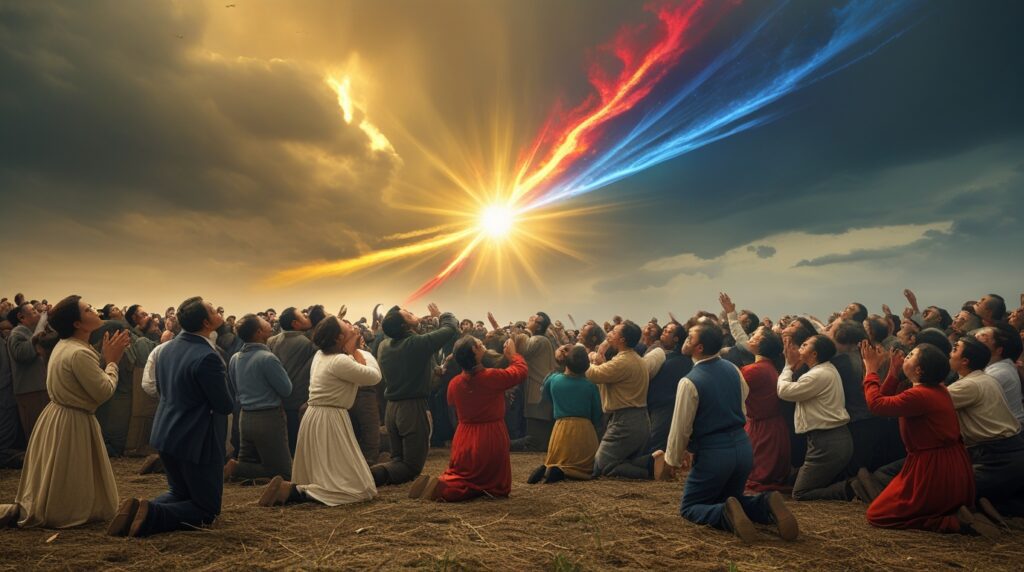
Have you ever wondered if your deepest religious beliefs might be built more on feeling than on truth?
For most of us, faith is not just an idea — it is an emotion. The warmth fills us during prayer, the tears that come from a song, and the peace that washes over us when we feel close to something higher.
But here’s the hard question:
What if those powerful emotions, the very ones that feel sacred, sometimes lead us away from truth instead of toward it?
When Faith Feels Right — Until It Doesn’t
I used to think my faith was rock solid because it felt so real. Every emotional moment — from hearing a moving sermon to feeling goosebumps during worship — seemed like proof that I was connected to something divine.
But then I noticed a pattern. Whenever those feelings disappeared, my certainty started to crumble. If my emotions were high, my faith was high. When my emotions faded, so did my conviction.
If you have ever experienced that cycle — the rollercoaster between spiritual highs and quiet doubts — you are not alone. Most of us have confused emotional intensity with spiritual truth. When something feels powerful, we assume it must be real.
Yet emotion can sometimes be a beautiful disguise for wishful thinking.
When Feelings Falter
Think about the most intense moments of faith you have experienced — a conversion, a religious retreat, a miraculous recovery, or a life-changing prayer. Those moments are unforgettable. They shake us to the core.
Nevertheless, what happens when that high fades? When the everyday returns, when prayers go unanswered, or when tragedy strikes?
That is when many of us start to question: Was my faith real, or was it just a feeling?
The truth is, emotions can override logic. When we are deeply attached to a belief, our minds naturally defend it — even if there are inconsistencies or unanswered questions. Psychologists call this cognitive dissonance — the mental discomfort we feel when our beliefs and facts do not align.
Instead of facing that discomfort, we often double down on what we already feel is true. Emotion protects belief like armor, shielding it from honest questioning.
And history shows how powerful — and dangerous — that emotional armor can be.
From the Crusades to cults, from zealotry to intolerance, passionate feelings have often justified irrational or harmful actions. Emotion makes us certain — sometimes more certain than we should be.
Belief and the Slippery Slope of Subjectivity

The real danger begins when emotion becomes the only compass for truth.
If you think about it, feelings are deeply personal. What feels sacred and right to one person may feel false to another. One person’s “divine revelation” can be another’s “illusion.”
If everyone’s feelings point in different directions, whose emotion leads to the truth?
That is the problem with emotional subjectivity: it creates endless versions of “truth.” Entire denominations, sects, and religious movements have split because people followed different emotional convictions — each sure that their inner peace was divine confirmation.
The heart can be sincere and still be wrong.
It can mistake comfort for truth, or confuse longing with revelation.
Sometimes, what we call a “spiritual sign” is really wish fulfillment — our mind giving emotional form to what we already want to believe. Other times, it’s confirmation bias — our emotions reward ideas that agree with us and reject those that do not.
Without reason, emotion can become a mirror — showing us only what we want to see.
Cultivating a Balanced Faith
None of this means we should abandon emotion. Far from it.
Faith without feeling is lifeless. However, faith based only on feeling is fragile.
A balanced faith welcomes both the heart and the mind. It is passionate yet thoughtful, emotional yet grounded.
The first step is intellectual honesty — asking the questions we often avoid.
- Do I believe this because it is true, or because it comforts me?
- Would I still hold this belief if it stopped feeling good?
- Do I read or listen to people who disagree with me, or only those who confirm what I already believe?
It takes courage to face those questions, but doing so deepens faith. It moves belief from emotion to understanding.
True spirituality can handle questions.
True faith does not collapse under doubt — it grows through it.
Try this: read about other faiths, study philosophy and science, listen to skeptics, not to argue, but to understand. You may not change what you believe, but you will change how you believe — with humility, depth, and self-awareness.
When Reason Meets Reverence
There is a beautiful harmony waiting when emotion and reason stop fighting each other.
Emotion gives faith its warmth; reason gives it structure. Together, they create something lasting — a faith that feels alive and makes sense.
When you combine heart and head, spirituality stops being fragile. You no longer need constant emotional highs to feel connected to something sacred. You do not panic when feelings fade, because your belief is not built on temporary emotion — it is grounded in understanding.
You start seeing your faith not as a possession, but as a journey — one that can survive silence, doubt, and even disappointment.
Awe does not disappear in this kind of faith — it becomes richer. You still feel wonder, but it is no longer a substitute for truth. It is an expression of it.
When Feelings Fade, Faith Can Still Stand
There will come a time when the warmth of belief cools. The prayer feels empty. The scripture feels distant. You might even wonder if you have lost your connection to the divine.
That is when emotion-based faith usually falls apart.
But that’s also where mature faith begins.
A resilient faith does not depend on constant emotional reassurance. It survives when feelings fail because it is grounded in something deeper — in truth sought through reflection, not just felt through passion.
You can still cry, still feel joy, still be moved by beauty and worship — but you know those feelings are expressions of your faith, not the proof of it.
And that makes all the difference.
Heart and Head – Partners, Not Enemies
Faith and reason do not have to be rivals. They can be partners — each strengthening the other.
Emotion keeps belief human; reason keeps it honest.
Emotion makes faith compassionate; reason makes it wise.
When the two work together, you find a spirituality that does not need to fear questions, science, or doubt. It is confident enough to investigate, patient enough to listen, and humble enough to admit it doesn’t have all the answers.
That’s the kind of faith the modern world needs — not blind conviction, but thoughtful conviction. Not cold logic, but enlightened warmth.
Because truth does not ask you to stop feeling — it asks you to start thinking while you feel.
A Call to Reflect on Your Belief
So here’s the question worth carrying with you:
When you believe — when you pray, when you defend your faith, when you feel inspired — are you guided by truth, or just by what feels right?
If the answer makes you uncomfortable, that is good. It means your faith is still alive enough to grow.
The goal is not to kill emotion; it is to understand it. To make it your ally, not your master.
Because the most unshakable faith isn’t the one that feels certain — it’s the one that keeps seeking, keeps questioning, keeps balancing the fire of the heart with the light of the mind. A mindfulness meditation might help here.
That is the kind of faith that does not just survive doubt — it thrives on it.